 GnawClaw
The $30,000 Lie: How VPS Hosting Influencers Are Scamming the Agentic AI Community, and Why Running OpenClaw Locally Destroys Their Entire Business Model
By GnawClaw | March 22, 2026
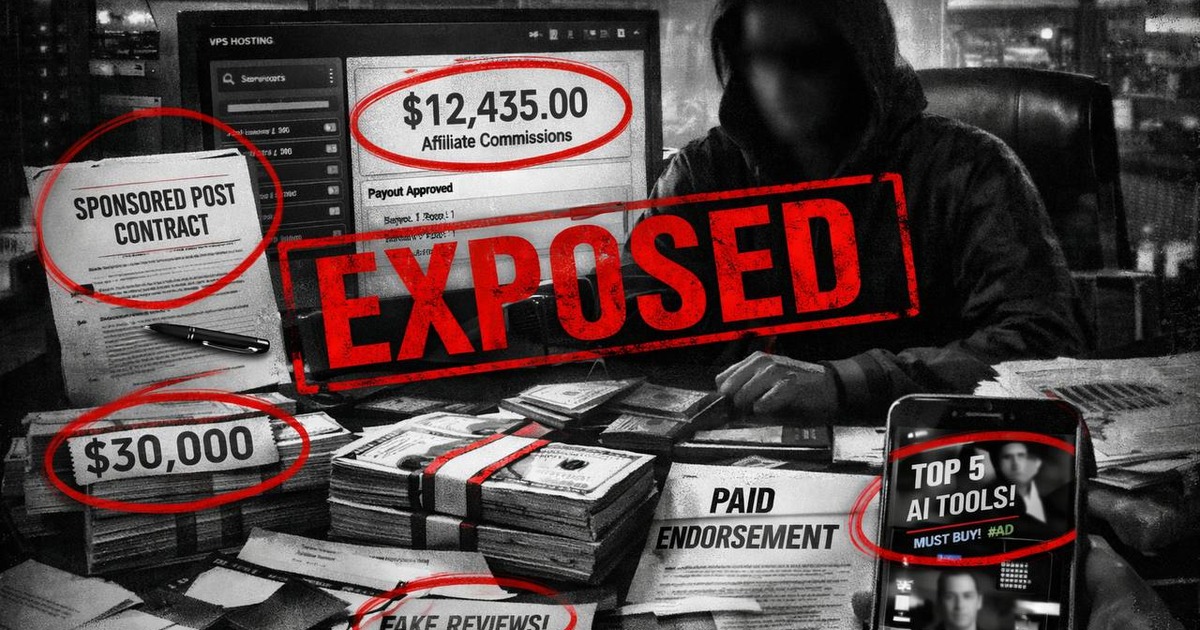
You have seen the videos. A polished productivity YouTuber stares into the camera and tells you that the "secret" to building your own agentic AI empire is renting a Virtual Private Server from Hostinger for $30 to $60 a month. They flash a promo code. They show a slick dashboard. They promise that you can run powerful AI models in the cloud, skip the API bills from OpenAI and Anthropic, and automate your entire business from a browser tab.
It is a lie. A highly lucrative, mathematically provable, and potentially FTC-violating lie.
The reality behind the "AI on a VPS" trend is not about democratizing artificial intelligence or empowering solopreneurs. It is about funneling millions of dollars into web hosting affiliate programs that pay influencers commissions of up to 60% on every sale they generate.1 Behind the slick editing and the tiny "#ad" disclosures lies a brutal, verifiable truth: running agentic AI on a shared CPU server is practically useless for real workloads, and the hardware sitting on your desk right now is almost certainly more capable than anything a budget VPS can offer.
At GnawClaw, we build autonomous AI systems that actually work. We deploy agentic frameworks like OpenClaw on local hardware, because the math demands it and the results prove it. Today, we are going to dismantle the VPS hosting narrative with cold, sourced, fact-checked data, and show you why running your agentic AI locally is the only mathematically sane choice for serious operators in 2026.
Part 1: Follow the Money, The Anatomy of the VPS Affiliate Racket
To understand why so many influencers are suddenly obsessed with convincing you to rent a VPS for your AI tools, you need to follow the money. The answer is not complicated. It is embarrassingly simple.
Web hosting affiliate programs are among the most aggressive and highest-paying referral systems on the internet. Hostinger, one of the most heavily promoted VPS providers in the AI influencer space, offers affiliate commissions starting at 40% per sale, scaling up to 60% as an affiliate's volume increases.1 One prominent affiliate marketing blog, BloggersPassion, publicly reports earning over $193,000 in total commissions from the Hostinger affiliate program alone, with monthly affiliate income exceeding $10,000 across their portfolio.1
Let us run the numbers on what this means for a single VPS recommendation. Hostinger's top-tier VPS plan, the KVM 8, offers 8 virtual CPU cores and 32GB of RAM at a price of $59.99 per month.2 If a viewer clicks an influencer's affiliate link and signs up for an annual plan, they pay $719.88 over 12 months. The influencer who referred them pockets between $287.95 (at the 40% tier) and $431.93 (at the 60% tier) for that single referral.1
| Commission Tier | Per-Referral Payout (KVM 8 Annual) | Referrals Needed for $30,000 |
|---|---|---|
| 40% Commission | $287.95 | 105 referrals |
| 60% Commission | $431.93 | 70 referrals |
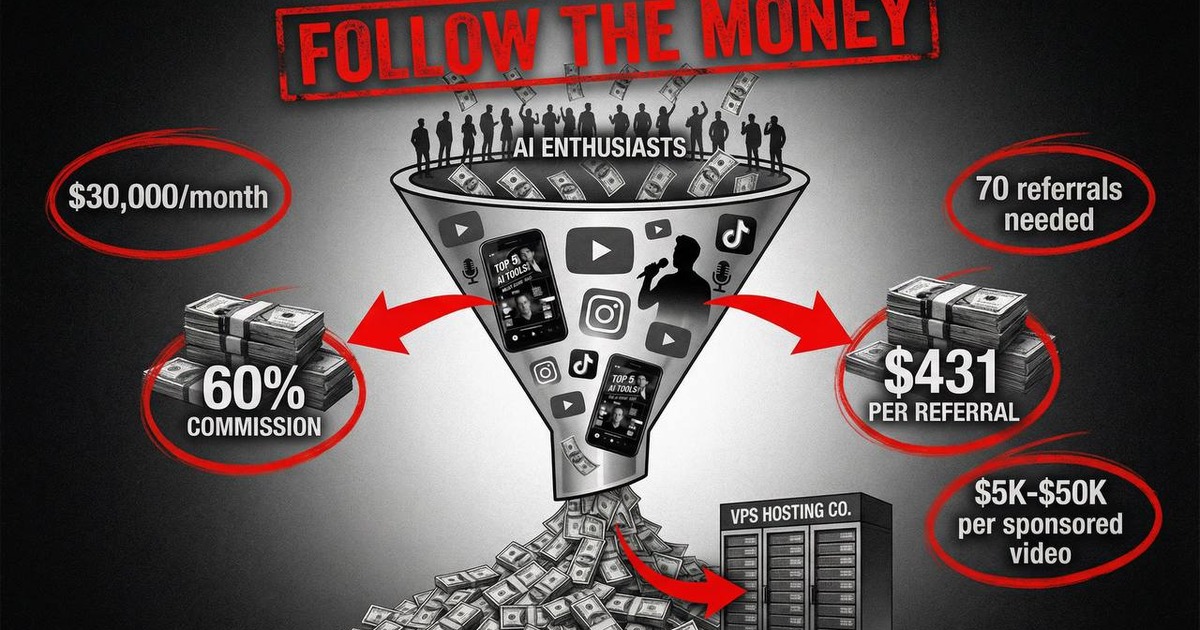
When you layer YouTube sponsorship payments on top of affiliate commissions, the incentive structure becomes even more distorted. According to industry data from CreatorsJet and Mediacube, YouTube sponsorship rates in 2026 typically range from $15 to $25 CPM. For channels with over 100,000 subscribers, flat-rate sponsorship deals commonly range from $5,000 to $50,000 per video.3,4 A single sponsored video with 500,000 views at a $20 CPM generates $10,000 in sponsorship revenue alone, before a single affiliate commission is counted.
This is not a victimless arrangement. Every dollar of affiliate commission comes directly from the pocket of a solopreneur, indie hacker, or small business owner who was told that a CPU-only VPS was the "best way" to run their agentic AI tools. Meanwhile, the influencer who made the recommendation is often running their own actual AI workloads on a $4,000 Mac Studio or a custom-built desktop with a dedicated GPU, hardware they conveniently never mention in the sponsored segment.
Part 2: The Technical Reality, Why VPS Hosting Fails Catastrophically for Agentic AI
The core deception of the VPS-for-AI narrative lies in the hardware specifications that most viewers never bother to check. When you purchase a standard VPS plan from Hostinger, DigitalOcean, Linode, or Vultr, you are renting shared virtual CPU cores. You are not renting a GPU (Graphics Processing Unit), which is the fundamental hardware component required for running Large Language Models efficiently.5
This distinction is not academic. It is the difference between a system that works and a system that is functionally broken.
What You Actually Get from a Top-Tier VPS
| Specification | Hostinger KVM 8 |
|---|---|
| Virtual CPUs | 8 (shared) |
| RAM | 32 GB |
| Storage | 400 GB NVMe |
| GPU | None |
| Bandwidth | 32 TB |
| Monthly Price | $59.99 |
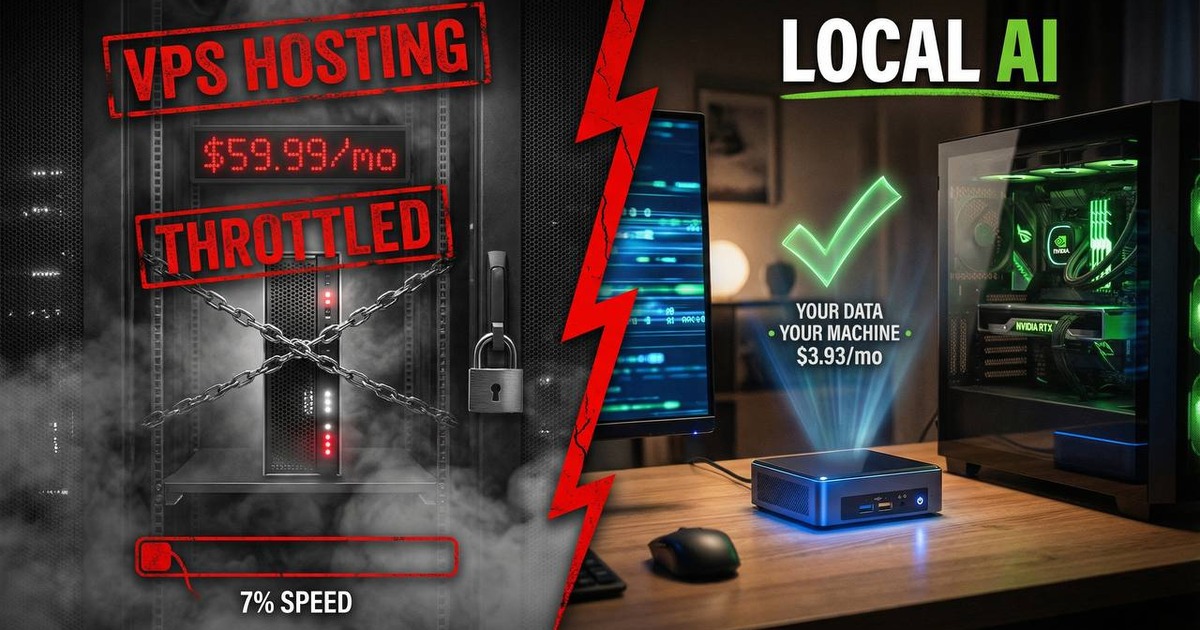
| CPU Throttling | Yes, activated after ~180 minutes of sustained usage above ~75%7 |
The CPU throttling policy is particularly damaging for AI workloads. According to multiple user reports on Reddit's r/Hostinger community, Hostinger implements automatic CPU throttling that reduces server capacity by 25% per hour once sustained CPU usage exceeds approximately 70-80% for more than 180 minutes.7 One user reported that their 8-core VPS went from processing 100,000 operations per second down to just 7,000, an 85-93% performance degradation, within two days of running a CPU-intensive application.7
"TL;DR: Hostinger throttles CPU capacity by 25% per hour if you exceed their undefined 'high CPU usage' threshold for 180 minutes. My 8-core VPS went from 100k to 7k processes/sec in less than 2 days."
, Reddit user Active-Plenty-2748, r/Hostinger7"You can only use the CPU at 35 percent for a few hours. The issue is that they downgrade your CPU to unusable amounts."
, Reddit user ddxv, r/Hostinger7The Token Speed Problem
Even without throttling, the raw performance of CPU-only inference is inadequate for real-time agentic workflows. Running a modest 8-billion parameter model (such as Llama 3.1 8B or Qwen 3 8B) on CPU-only hardware typically produces output at 1 to 5 tokens per second.8 For context, a comfortable conversational speed requires approximately 15 to 30 tokens per second. An agentic workflow that chains multiple tool calls, reasoning steps, and memory lookups will feel unbearably slow at CPU speeds, and will often time out entirely.
By contrast, the same 8B model running on a consumer-grade NVIDIA RTX 4070 with 12GB of VRAM produces output at 40 to 80+ tokens per second.8 That is not a marginal improvement. It is an order-of-magnitude difference that separates a functional AI agent from a broken one.
Get the Local AI Playbook — Free
12 pages. Exact hardware, real costs, copy-paste commands, and the 11 bugs we hit so you can skip straight to what works. Instant download.
No spam. Unsubscribe anytime. GnawClaw never sells emails.
Part 3: The Local AI Renaissance, OpenClaw and the Death of the Cloud Tax
The alternative to the VPS racket is already here. It has over 100,000 GitHub stars. It drew 2 million visitors in a single week. And it was explicitly designed to run on your own machine.
OpenClaw is an open-source agentic AI platform created by Austrian software engineer Peter Steinberger.9 Originally launched as "Clawd" in November 2025 (later renamed after Anthropic's legal team requested a change), OpenClaw connects to the messaging platforms you already use, WhatsApp, Telegram, Discord, Slack, and Microsoft Teams, and turns your local hardware into a 24/7 autonomous AI operating system.9
"OpenClaw is an open agent platform that runs on your machine and works from the chat apps you already use. [...] Your assistant. Your machine. Your rules."
, Peter Steinberger, OpenClaw Blog9The Real Cost of Running OpenClaw Locally
The economics of local AI deployment are devastating for the VPS narrative. Every figure below uses verified, sourced data. Electricity costs are based on the U.S. national average residential electricity rate of 17.24 cents per kWh (EIA, December 2025).10 Power consumption figures are based on actual measurements taken with a Kill A Watt electricity monitor.11
| Scenario | Hardware Cost | Monthly Electricity | 3-Year Total Cost | AI Capability |
|---|---|---|---|---|
| Hostinger KVM 8 VPS | $0 upfront | $59.99 | $2,159.64 | CPU-only, throttled, no GPU |
| Mini PC (Beelink SER7) | $450 one-time | $3.93 | ~$591 | 7B-14B models, iGPU acceleration |
| Budget AI Desktop (RTX 4060) | $899 one-time | $10.55 | ~$1,279 | 7B-13B models, dedicated GPU |
| Sweet Spot (RTX 4070) | $1,599 one-time | $10.55 | ~$1,979 | 30B+ models, 12GB VRAM |
The breakeven analysis is unambiguous:
| Comparison | Breakeven Point | Monthly Savings After Breakeven |
|---|---|---|
| Mini PC ($450) vs. Hostinger KVM 4 ($34.99/mo) | 14.5 months | $31.06/month |
| Sweet Spot PC ($1,599) vs. Hostinger KVM 8 ($59.99/mo) | 32.3 months | $49.44/month |
After the breakeven point, your local AI infrastructure costs you nothing beyond a few dollars of electricity per month. The VPS bill, by contrast, never stops. It compounds month after month, year after year, with zero equity and zero hardware ownership at the end.
Part 4: The Agentic AI Market Is Exploding, and the Stakes Have Never Been Higher
The reason this matters now, more than ever, is that agentic AI is not a niche experiment anymore. It is a global market undergoing explosive growth.
According to Fortune Business Insights, the global agentic AI market was valued at $7.29 billion in 2025 and is projected to reach $139.19 billion by 2034.12 Grand View Research projects the broader AI agents market at $7.63 billion in 2025, reaching $182.97 billion by 2033 at a CAGR of 49.6%.13 A joint IDC and AWS study found that 65% of organizations expect full agentic AI deployment by 2027, while MIT Sloan Review reports that agentic AI has already reached 35% adoption with another 44% of organizations planning deployment.14,15
These are not speculative projections. Enterprises are already deploying agentic systems at scale, and the infrastructure decisions being made today, cloud versus local, rented versus owned, will determine who controls the AI stack for the next decade.
Part 5: The FTC Is Watching, and the Penalties Are Severe
The web hosting affiliate gravy train is on a collision course with federal regulators. The Federal Trade Commission has been escalating enforcement against deceptive AI marketing practices throughout 2024 and 2025.
In September 2024, the FTC launched "Operation AI Comply," announcing five simultaneous law enforcement actions against companies that used AI hype to supercharge deceptive or unfair conduct.16 The FTC's Consumer Review Rule, which went into effect on October 21, 2024, explicitly prohibits the creation, sale, or purchase of fake reviews, including those generated by AI, and empowers the Commission to seek civil penalties of up to $53,088 per violation.17
The FTC's updated Endorsement Guides (revised June 2023) require that material connections between endorsers and advertisers be disclosed "clearly and conspicuously."18 Burying "#ad" in a sea of hashtags or at the bottom of a video description does not meet this standard.
For influencers earning 40-60% commissions on VPS sales while telling their audience that a CPU-only server is "the best way to run AI," the legal exposure is significant. The FTC has already sent warning letters to influencers across multiple industries and has demonstrated a willingness to pursue enforcement actions against both the brands and the individual creators involved in deceptive endorsement practices.
Part 6: Build Your Agentic AI Empire Locally, The GnawClaw Way
At GnawClaw, we refuse to participate in the cloud tax grift. We build premium autonomous AI systems and brutally practical products that help solopreneurs, consultants, and small businesses automate the work that keeps slowing them down, without bleeding cash to SaaS subscriptions or predatory hosting providers.
Our approach is simple: no SaaS subscriptions, you own everything, and your monthly AI operating cost is approximately $50 in API fees, not $60 in VPS rent for a server that throttles you the moment you actually use it.
We have deployed 17 autonomous systems and tracked over 13,900 AI profiles. We sell an OpenClaw Quickstart Kit for $10 that gets you installed, verified, and running in an afternoon. We know what works because we run it ourselves, every day, on local hardware.
Here is the playbook:
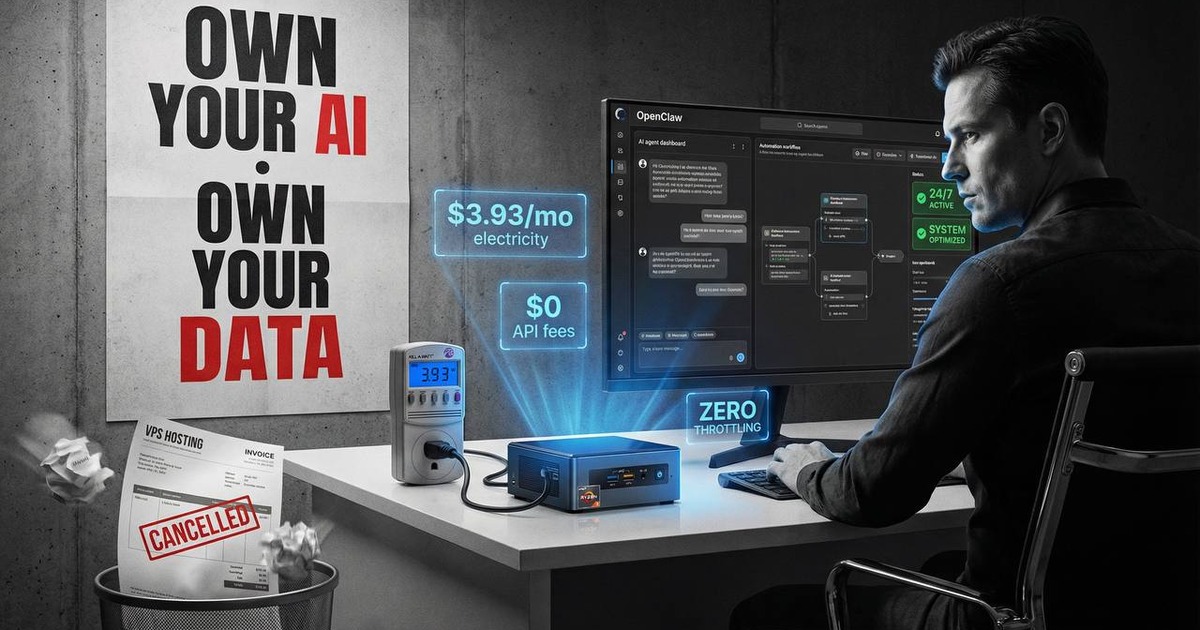
- 1 Cancel the VPS. Stop paying $30 to $60 a month for shared CPU cores with no GPU and aggressive throttling policies. That money is gone forever with zero equity.
- 2 Buy local hardware. A $450 mini PC with 32GB of RAM runs OpenClaw and 7B-14B parameter models comfortably. If you want serious power, a $1,599 build with an RTX 4070 runs 30B+ models with GPU acceleration. Both options pay for themselves within 14 to 32 months compared to VPS costs.
- 3 Install OpenClaw. Connect it to your WhatsApp, Telegram, or Discord. Deploy your models through Ollama. Your agentic AI system is now running 24/7 on hardware you own, with data that never leaves your machine, at an electricity cost of $4 to $11 per month.
- 4 Scale with GnawClaw. When you are ready for deeper automation, multi-agent workflows, AI departments, enterprise-grade monitoring, we build it for you, starting at $497.
The era of paying rent on someone else's throttled CPU to run your AI agent is over. The math does not lie. The hardware is affordable. The software is open source. The only people who benefit from the VPS narrative are the influencers cashing affiliate checks and the hosting companies collecting your monthly payments.
Own your infrastructure. Own your data. Own your AI.
Your business should still be moving at 3AM, on a machine that belongs to you.
Get Running on Local Hardware Today
The OpenClaw Quickstart Kit gets you installed, verified, and running in an afternoon. No VPS. No monthly bill. No throttling.
References
- Anil Agarwal. "Hostinger Affiliate Program Review (2026): Earnings & More." BloggersPassion, February 18, 2026.
- "Hostinger: Performance, Features and Prices." VPS Benchmarks, February 28, 2026.
- "How Much Do Brands Pay for YouTube Sponsorships? (2026 Rates)." CreatorsJet, August 5, 2025.
- "YouTube Sponsorship Rates: How Much Do Sponsors Really Pay?" Mediacube, November 28, 2025.
- "VPS Hosting Parameters and Limits." Hostinger Support.
- "VPS Hosting | Powerful KVM-based Virtual Private Server." Hostinger.
- Active-Plenty-2748. "Is Hostinger lying about what they offer. Why get an 8-core VPS if you can't actually use all the cores?" Reddit r/Hostinger, November 12, 2025.
- "Running Local LLMs, CPU vs. GPU, a Quick Speed Test." Dev.to / Maxim Saplin, March 11, 2024.
- Peter Steinberger. "Introducing OpenClaw." OpenClaw Blog, January 29, 2026.
- Caitlin Ritchie. "Electricity Rates by State (March 2026)." Choose Energy / U.S. Energy Information Administration, March 4, 2026.
- Brian Peiris. "How Much Energy Does Local AI Use?" February 20, 2026.
- "Agentic AI Market Size, Share & Forecast Report [2026-2034]." Fortune Business Insights.
- "AI Agents Market Size and Share | Industry Report, 2033." Grand View Research.
- "Agentic AI Adoption: 5 Key Trends Driving Enterprise Growth." IDC / AWS.
- "The Emerging Agentic Enterprise: How Leaders Must Navigate a New Age of AI." MIT Sloan Management Review, November 18, 2025.
- "FTC Announces Crackdown on Deceptive AI Claims and Schemes." Federal Trade Commission, September 25, 2024.
- "Keeping it Real: FTC Targets Fake Reviews in First Consumer Review Rule." Crowell & Moring, December 24, 2025.
- "Advertisement Endorsements." Federal Trade Commission.
GnawClaw builds premium AI systems and brutally practical $10 products for solopreneurs and small businesses. Visit gnawclaw.com to get started.