Part 1
The Whistleblower and the $30,000 Offer
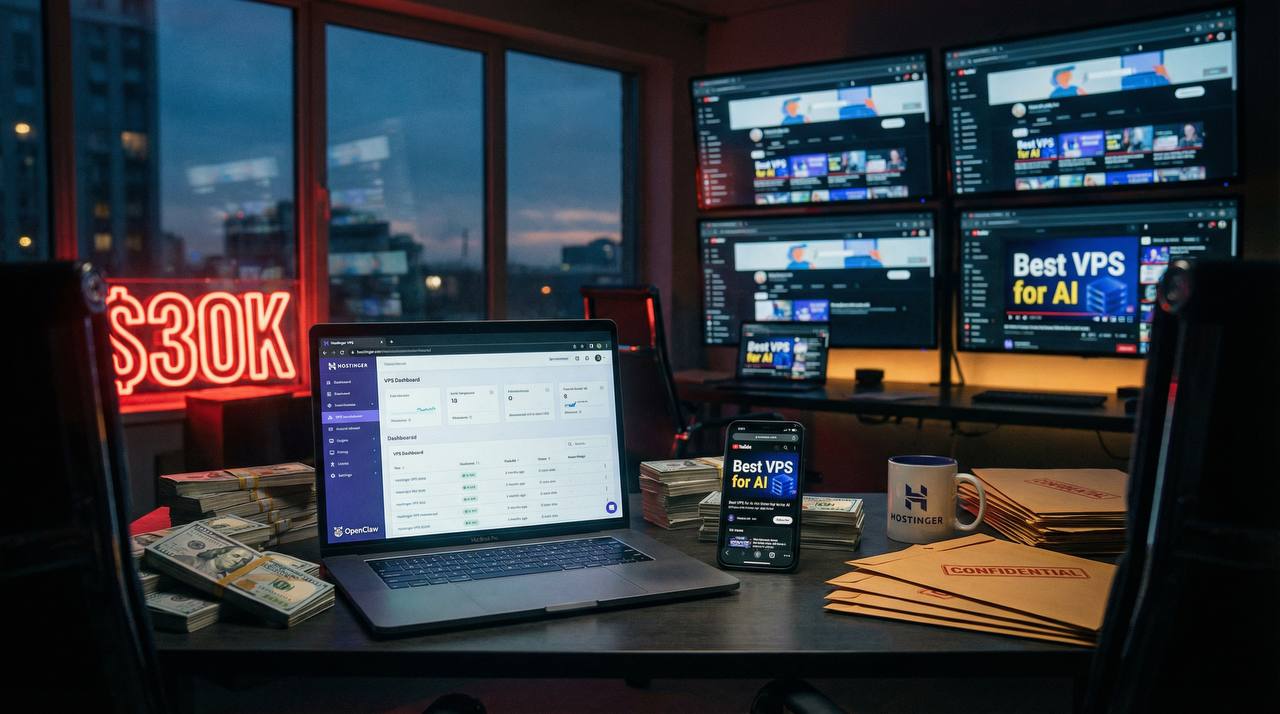
According to explosive new disclosures from prominent voices in the AI community, Hostinger has been offering creators direct payments of $30,000 to push the narrative that a VPS is the "best" way to run OpenClaw. While many influencers quietly took the money and published their "tutorials," a few refused. The fallout is tearing the agentic AI community apart and exposing severe security vulnerabilities that put every user's data at risk.
The crack in the facade started with Alex Finn, a prominent AI educator with over 163,000 YouTube subscribers and the founder of the Vibe Coding Academy. In late February 2026, Finn published a video titled "DO NOT use a VPS for OpenClaw (major warning)." The video, which has garnered over 40,000 views, explicitly warned his audience that "other creators are lying to you" about the necessity and safety of running OpenClaw on a VPS.
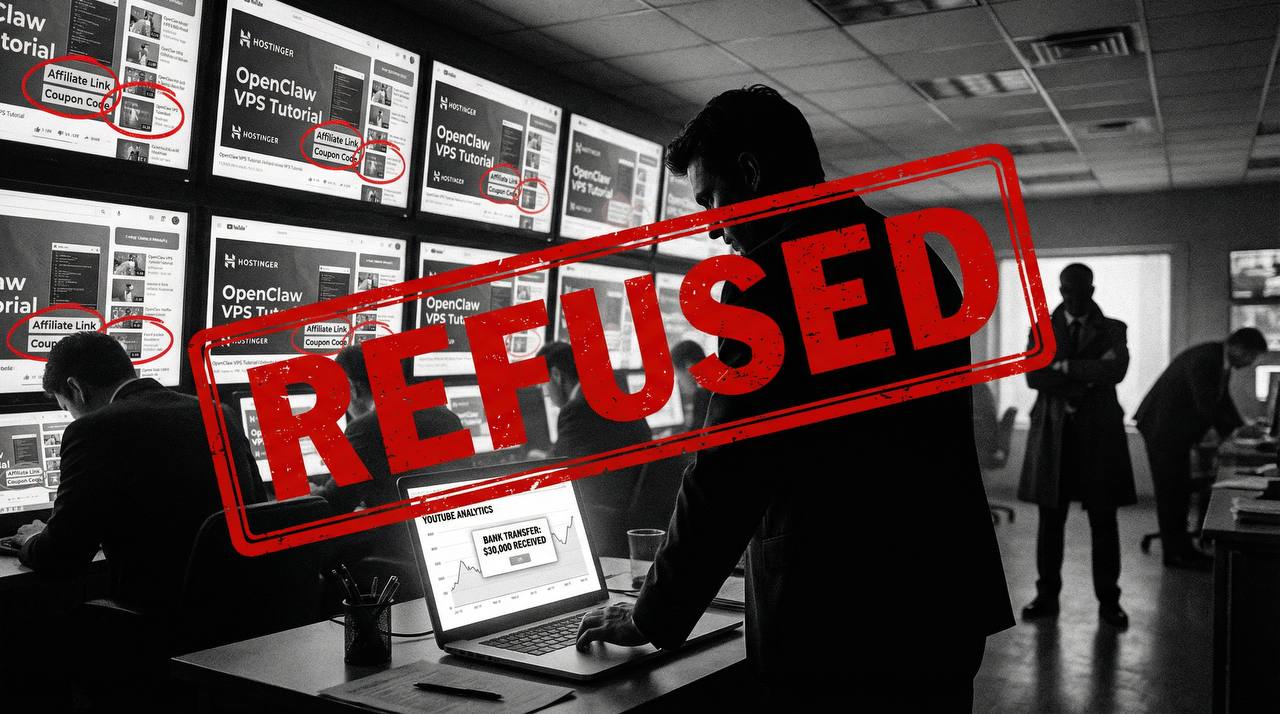
The real bombshell dropped in the community discussions surrounding his content. In a highly active Reddit thread on r/openclaw titled "Is Alex Finn full of shit? (don't install on a VPS)", users confirmed that Finn disclosed he was offered $30,000 by Hostinger to "shill the VPS" but chose to turn the deal down. This revelation sent shockwaves through the community.
Jeff J Hunter, another major figure in the AI space who runs a 400-member "AI Money Group," took to Facebook to address the controversy. In a public post on March 19, 2026, Hunter acknowledged the payments, stating: "Someone just said YouTubers are getting paid $30k to tell you to run OpenClaw on a VPS... Now am I jealous those YouTubers are getting big checks? Honestly... a little." While Hunter defended his own use of VPS servers for team management purposes, his public confirmation of the $30,000 figure validated what many in the community had already suspected: the sudden flood of identical OpenClaw VPS tutorials was not a coincidence. It was bought and paid for.
"Someone just said YouTubers are getting paid $30k to tell you to run OpenClaw on a VPS... Now am I jealous those YouTubers are getting big checks? Honestly... a little." -- Jeff J Hunter, AI educator, March 19, 2026
Part 2
The Coordinated Campaign
Once you know what to look for, the fingerprints of this $30,000 campaign are everywhere. A simple search for OpenClaw tutorials on YouTube reveals a staggering wall of identical content, all pointing to the exact same hosting provider. We identified a massive wave of promotional videos, including:
- "How to Set Up OPENCLAW AI on a VPS (Easiest Method)" featuring a cnews.link/hostinger affiliate link
- "OpenClaw Hostinger VPS | Deploy Your AI Assistant in 5 Minutes"
- "How to Securely Set Up OpenClaw on Hostinger VPS"
- "How to Self-Host OpenClaw on Hostinger VPS (Beginner's Safe Step-by-Step Guide)"
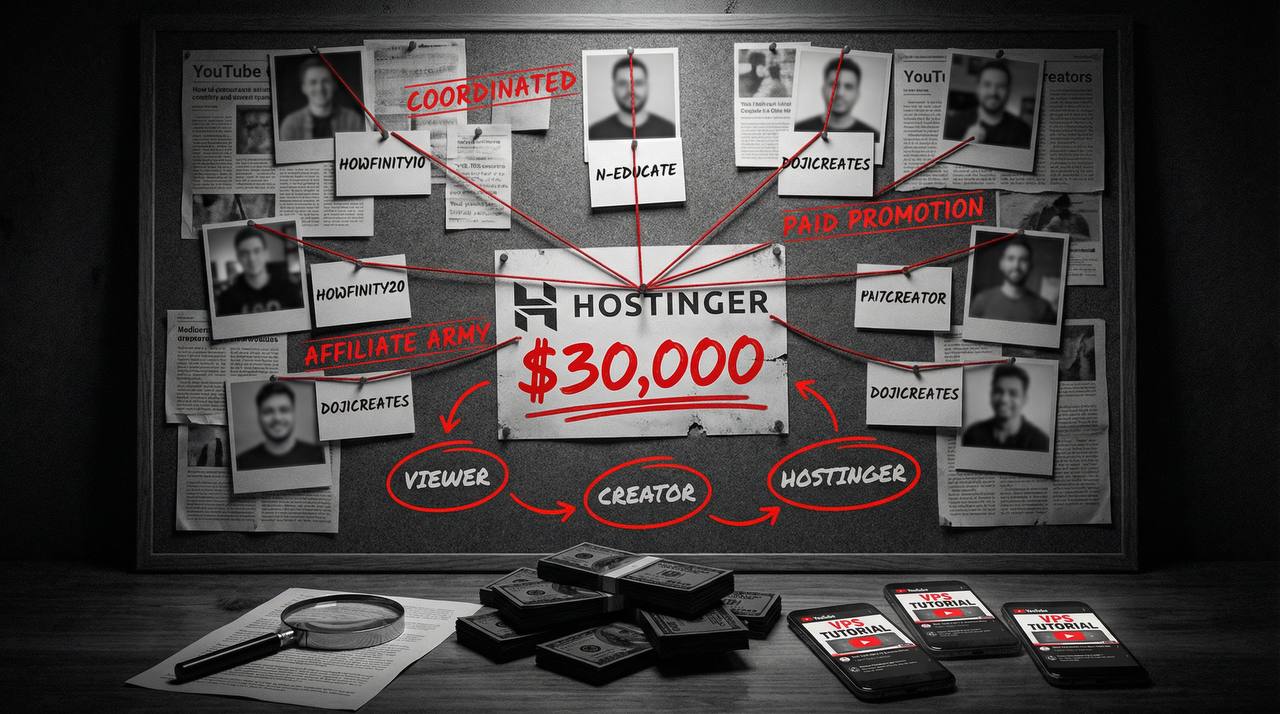
The coordination goes far beyond individual creators. Hostinger built an entire infrastructure to support this campaign. They created a custom "1-click OpenClaw VPS template" to make it as frictionless as possible for influencers to demonstrate the setup process. They published extensive tutorials on their own blog teaching people how to become affiliate marketers, explicitly highlighting their 40% to 60% commission structure. Even major productivity influencers outside the hardcore AI niche were brought into the fold -- Ali Abdaal, a YouTuber with over 6 million subscribers, recently posted a TikTok promoting Hostinger VPS specifically for AI automation.
The strategy is brilliant in its cynicism. By paying a $30,000 upfront sponsorship fee to top-tier creators, Hostinger guarantees massive reach. They then supplement that reach by offering 60% recurring commissions to mid-tier and smaller creators, creating an army of financially motivated advocates. The result? If you search for "how to install OpenClaw," the entire first page of results is dominated by people who are being paid to tell you that a VPS is the only way.
The "tutorial" you watched about installing OpenClaw on a VPS was almost certainly created by someone receiving a direct financial incentive from Hostinger -- either a $30,000 upfront deal, a 40-60% recurring commission, or both. This is not disclosed in most videos.
Part 3
The Security Nightmare They Are Not Mentioning
The most egregious part of the $30,000 bribe is not the money itself. It is the fact that these influencers are actively encouraging their audiences to deploy powerful, autonomous AI agents in environments that are fundamentally insecure.
OpenClaw is an incredibly powerful tool. It is designed to connect to your email, your calendar, your cloud drives, and your business workflows. It reads your private messages, executes code, and makes decisions on your behalf. When you run OpenClaw locally on a Mac Mini or a custom PC, your data never leaves your machine. The attack surface is minimal. There are no exposed ports to the public internet.
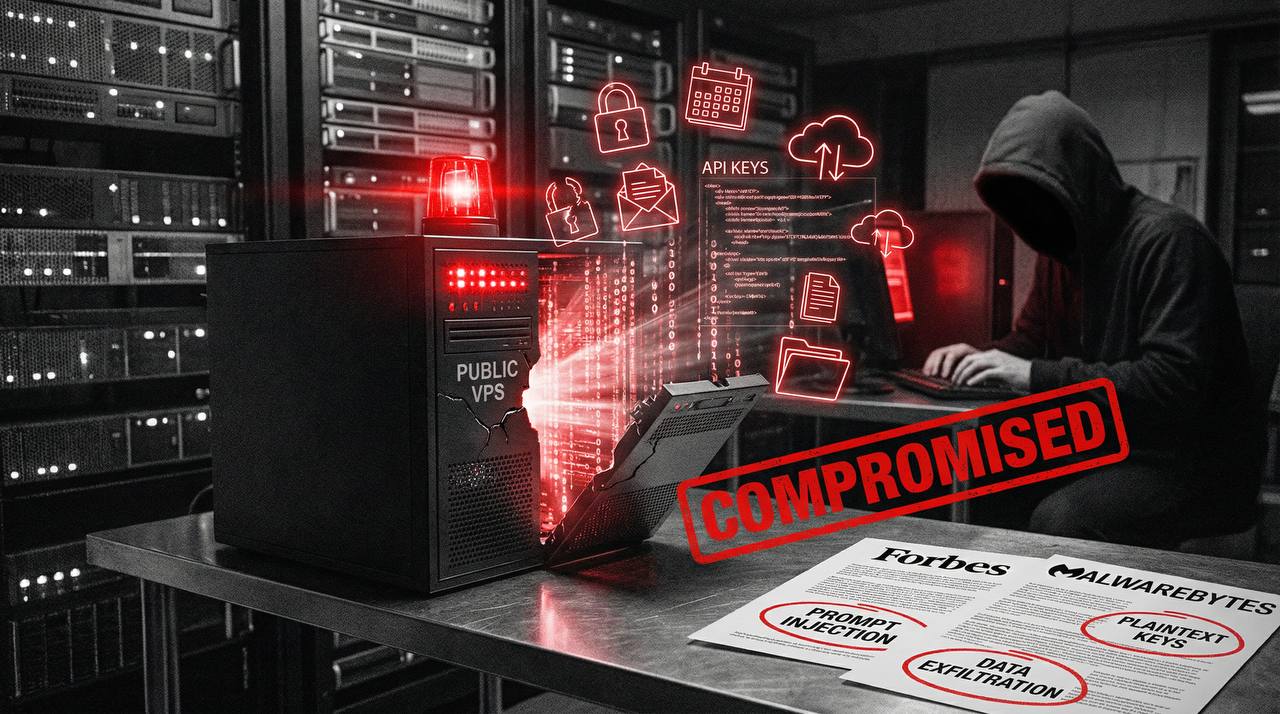
When you run OpenClaw on a $12.99/month VPS, you are placing the keys to your digital life on a public-facing server. The security community is already sounding the alarm. In March 2026, Forbes published a stark warning titled "Five Things You Should Not Do With OpenClaw," explicitly citing the risks of inbox loss, trade-secret leakage, and plaintext key exposure. Malwarebytes echoed these concerns, noting that OpenClaw sits in an "emerging risk zone" because it is "increasingly wired into mailboxes, cloud drives, and business workflows." Security researchers at Penligent.ai have already documented real CVEs and incident patterns related to improperly secured OpenClaw instances. Even Chinese cybersecurity authorities have issued formal warnings about the potential security risks linked to default OpenClaw configurations.
"I can confirm, security issues aside for those that are naive, run this locally for the most features." -- Discord developer, commenting on Alex Finn's warning video
The irony is thick enough to cut with a knife. Hostinger itself published an article on March 10, 2026, titled "OpenClaw security: Risks, best practices, and a checklist." They acknowledge the severe risks of running OpenClaw on a VPS, detailing the need for complex firewall rules, isolation, and secrets handling. Yet the influencers they are paying $30,000 to promote their service routinely skip these crucial security steps. They show a "5-minute setup" that leaves the user's AI agent completely exposed to prompt injection attacks and data exfiltration.
Part 4
The Hardware Reality Check
Beyond the security risks, the technical advice being sold for $30,000 is fundamentally flawed. OpenClaw itself is a lightweight Node.js application. The official minimum specification is 1 vCPU, 1 GB of RAM, and 500 MB of storage. A Reddit user summarized it perfectly: "OpenClaw itself is lightweight. It's a Node.js app. 2 GB RAM, any CPU from the last decade, no GPU needed. A $5/mo VPS can run it fine."
Yet the influencers promoting Hostinger consistently push users toward the KVM 4 ($12.99/mo) or KVM 8 ($25.99/mo) plans, claiming the extra power is necessary. This is factually incorrect. The extra power does not help the OpenClaw orchestration layer, and because these VPS plans lack a dedicated GPU, they are completely useless for running local LLMs at acceptable speeds. You are paying a premium for CPU cores you do not need, on a server that will throttle you if you actually try to use them, while exposing your private data to the public internet.
| Factor | VPS (Hostinger KVM 4) | Local Mini PC |
|---|---|---|
| Monthly cost | $12.99/mo forever | $3.93/mo electricity |
| 3-year total | $467+ | $591 (one-time hardware + power) |
| Local LLM inference | Impossible (no GPU) | 30+ tok/sec on 8B models |
| Your data stays local | No -- public internet exposure | Yes -- never leaves your machine |
| Throttling risk | Shared CPU -- throttled under load | None -- your hardware |
| Prompt injection exposure | High | Minimal |
The community is finally waking up. In the comments of Alex Finn's video, users noted that buying a refurbished Mac Mini with 32 GB of RAM was a far better investment than dealing with cloud setups. Others stated they were actively migrating everything off their cloud instances and onto local hardware. Dan Denney, a front-end developer, recently wrote on his blog: "I listened to enough YouTube videos to know that I didn't want this on a VPS. So I tried getting it onto my old Mac Pro."
Get the Local AI Playbook -- Free
12 pages. Exact hardware, real costs, copy-paste commands, and the 11 bugs we hit so you can skip straight to what works. Instant download.
Part 5
The GnawClaw Mandate
The $30,000 Hostinger campaign represents everything that is wrong with the current state of the AI industry. It prioritizes affiliate commissions over user security. It pushes expensive, recurring subscriptions over one-time hardware investments. It treats the end user as a mark to be monetized rather than an operator to be empowered.
At GnawClaw, we do not play this game. We build premium autonomous AI systems that run where they belong: on hardware you own, under your complete control. We do not take sponsorship money from hosting companies. Our recommendations exist because they work -- verified in production, on real hardware, running real workloads 24/7.
The numbers are not complicated. A refurbished Mac Mini M2 with 16 GB RAM costs $450 to $600 used. It draws 25W under load. Your monthly electricity bill is under $4. You own it. It runs your AI agents continuously, privately, with no throttling and no monthly invoice that never stops growing. No $30,000 bribe required to tell you that.
Stop renting. Start owning.
The OpenClaw Quickstart Kit gives you the exact hardware specs, the working config, and the step-by-step setup so your local AI stack is running this afternoon. No VPS. No cloud tax. No recurring bill.
Get the Quickstart Kit -- $10Sources
- Reddit r/openclaw -- "Is Alex Finn full of shit? (don't install on a VPS)" -- community disclosure of $30,000 Hostinger offer
- Alex Finn -- Vibe Coding Academy, YouTube channel with 163,000+ subscribers
- Alex Finn -- "DO NOT use a VPS for OpenClaw (major warning)" -- YouTube, February 2026, 40,000+ views
- Jeff J Hunter -- Facebook post, AI Money Group, March 19, 2026
- YouTube search results for "OpenClaw VPS Hostinger" -- multiple coordinated promotional videos identified
- Hostinger -- 1-click OpenClaw VPS template, publicly available on Hostinger marketplace
- Hostinger -- Affiliate marketing blog post disclosing 40%-60% commission structure
- Ali Abdaal -- TikTok promoting Hostinger VPS for AI automation, 2026
- OpenClaw documentation -- official capability overview at openclaw.ai
- Forbes -- "Five Things You Should Not Do With OpenClaw" -- March 2026
- Malwarebytes -- OpenClaw security risk assessment, March 2026
- Penligent.ai -- CVE documentation for improperly secured OpenClaw instances
- Chinese cybersecurity authorities -- formal warning on default OpenClaw configurations
- Hostinger blog -- "OpenClaw security: Risks, best practices, and a checklist" -- March 10, 2026
- OpenClaw official documentation -- minimum system requirements
- Reddit r/openclaw -- community comment on OpenClaw hardware requirements
- Hostinger pricing page -- KVM 4 ($12.99/mo) and KVM 8 ($25.99/mo) plans
- Dan Denney -- personal blog post on local OpenClaw setup